There have been many changes in publishing, media, and the modes to access them in recent years. The rights of the author and the publisher in this quickly changing environment is sometimes a matter of conflict for the key players--hence the Hollywood writers strike over internet access and downloads. It is also a matter of confusion for universities and faculty trying to establish electronic reserve readings for students.
In the recent past, faculty felt free to capture online texts from library databases or the web, or even scan items (like book chapters) they wanted students to read and email them to students, or put up links to these "digital" copies for students to access, read, and print. This was considered by many one of those "grey areas" of copyright that fell close enough to "fair use" to be safe and acceptable.
Well, that grey area seems to be becoming less grey.
Articles are starting to appear in the media that indicate that some universities are taking the lead in treating online readings the same way they would paper reading packets. See, for example, this recent news item from Publisher's Weekly:
http://www.publishersweekly.com/article/CA6523686.html?nid=2286&source=title&rid=110462130
Three universities, following the earlier lead of Cornell, have signed an agreement with the Association of American Publishers that "affirms that digital materials will be governed by the same copyright principals [sic] used for print materials."
Who knows? Even providing PURLs (stable links) to articles in databases that the Library leases may be becoming problematic. Already, journals like the Harvard Business Review add a note to their PDFs in our Business Source Complete database indicating that their articles are “not intended for use as assigned course material." They add that they are "pleased to grant permission to make this work available through “electronic reserves” or other means of digital access or transmission to students enrolled in a course” as long as you contact them for “rates and authorization.”
The librarians of Sawyer Library are not copyright attorneys, so we cannot give you definitive advice about what is proper and what is not. However, we did want to let faculty know that free and easy distribution of the work of others, without obtaining specific permission to do so, may not be the "fair use" they think it is!
Monday, January 21, 2008


Friday, January 18, 2008
Sawyer Library Expands Weekend Hours
Thanks to University funding of additional staff hours, the Mildred F. Sawyer Library is happy to announce that we have expanded our weekend hours. We are opening earlier and closing later on both Saturday and Sunday to allow students to better utilize our library facilities and services. Hours on Saturday will now be 8am to 8pm. And on Sunday our hours will now be 11am to 11pm.
To check on our regular hours and any planned changes, please check this Library hours page.
Since hours can change during holidays, breaks, inter-sessions, and major national holidays, it never hurts to consult this page as you do your research planning. Keep in mind, especially during the coldest and stormiest days of winter, that if the University closes because of inclement weather, the library will close, as well.
Because our hours page is part of a University webpage server which only updates once daily (at best), if there are any weather changes, your best bet is simply to pay attention to notices you receive from the University notification system or information found on the University homepage or closure announcements that can be found on most local TV stations.
With more hours to serve you, we look forward to seeing you at the library this Spring Semester!
Tuesday, January 8, 2008
New and Improved Content for Legal Researchers in Lexis/Nexis Academic

This past summer Lexis/Nexis Academic gained valuable content in the areas of state regulatory codes and in Shepard's Citations.
Regulations are administrative rules or codes which implement laws. Access to state regulations and registers (updated regulations) had previously not been available through the Lexis/Nexis Academic. They are available now, and the most efficient way to locate a state's regulations is to select the tan-colored 'Sources' tab on the opening search screen.

Choose 'Administrative Materials & Regulations,' and then select 'Regulatory Codes. '
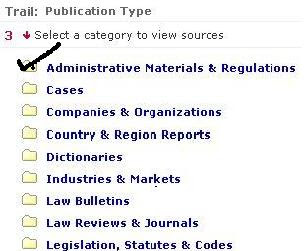
From the drop-down menu, code select the listing which alphabetically includes your state.
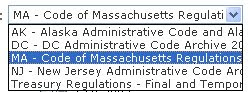
For the most current information, check MA- Code of Massachusetts Regulations (CMR) and Massachusetts Register. The user can search by using key terms and connectors and/or by utilizing the 'Document Section' drop-down menu, where a citation to the CMR may be entered.
 Lexis/Nexis Academic's Shepard's Citations includes lists of citations indicating every time a decision is cited or affected by a subsequent decision. In previous years, users could utilize Shepard's Citations only with U.S. Supreme Court cases. Now Lexis/Nexis Academic offers this outstanding service for state cases, other federal cases, and for law reviews. Choose the 'Legal Tab,' and select Shepard's Citations from the right-hand menu. Enter the proper citation in the opening box.
Citation Example: 405 Mass. 191
Shepard's results will show all citing references plus provide analysis. See the Lexis/Nexis Shepard's tutorial. http://web.lexis.com/help/multimedia/shepards.htm
Lexis/Nexis Academic has provided another enhancement which aids the student conducting legal research. Now highlighted links within statutes, cases, and law reviews lead the user to the full-text of these publications with one click of the mouse. Check out all of the Lexis/Nexis Academic legal enhancements today.
[Find Lexis/Nexis Academic in the A-Z List of Databases and in Databases by Subject on the Mildred F. Sawyer Library home page.]
Thursday, December 20, 2007
New Database: Science Reference Center
We have recently added a new database available on the familiar EbscoHost platform. The database is called Science Reference Center and it is good, basic, largely full-text database for science topics.
Because Science Reference Center is a broad audience science database, meant to serve high schoolers as well as college users, it is sometimes too basic. That is, it does not have the same depth of coverage as a good University-oriented database like Academic Search Complete. Nor does it provide the kind of specialized science journals that you might find in a subject-specific academic database like BioOne. Science majors doing advanced topics will find these higher level databases to be a better option for their research.
However, sometimes a student in anything from an English to a Communications to a Sociology class might need to get quick access to an assortment of good articles on a science or medical subject without sorting through the multi-subject false drops in a general academic database, or pulling up the more esoteric and overly-scholarly articles in a higher-level science database. These students will be well served by Science Reference Center.
For example, if I do a search for breast cancer, I get a variety of results:
 These include good basic news journals like "Science News," but also recognizable academic journals like the "American Journal of Public Health"--both available full-text. And because this is an Ebsco database, there are familiar functions like narrowing by subject heading (in the left frame), or limiting to peer-reviewed journals from the opening search screen check-box.
I you need just a few quick articles on a topic related to medicine or the sciences, Science Reference Center can be a useful tool.
[FIND Science Reference Center on our "Databases by Subject" List in the "Sciences" category.]
Thursday, December 6, 2007
Notable E-Book: Blackwell Encyclopedia of Sociology

I have extolled the virtues of electronic reference books before. They are easy to search and easy to access from anywhere you have an internet connection and a valid, current Suffolk ID number. But there is sometimes another key advantage to electronic reference sets, and that is that publishers often don't just close out the content with the publication of the print version. They actually continue to revise, update, and add fresh content. This kind of continuing effort does not occur with all eReference, but it is the case in our latest Notable E-Book, the Blackwell Encyclopedia of Sociology.
This current (2007) encyclopedia is based on a companion print resource of some 11 volumes. Our electronic version has all of the over 1800 entries in the paper set, but also includes regular updates--there have been two so far --of new and revised entries and other features. I've just received notice that 20 new entries have been added. These include Adoption, Biosociology, Global Warming, Practice Theory, Sweatshops, as well as several biographical entries on famous figures like Kant and Darwin.
Blackwell, a respected publisher, says of the encylopedia: "This ground-breaking project brings together specially commissioned entries written and edited by an international team of the world's best scholars and teachers. Published simultaneously in print and online, it contains...clear, concise, expert definitions and explanations of the key concepts, entries ranging from short definitions of key terms to extended explorations of major topics, both classical sociology and contemporary developments in the field, and introductions to sociological theories and research that have developed outside of the United States and Western Europe. "
The online version is not particularly elegant in design, but it is serviceable. Search for key words in the search box in the upper right of the screen, or browse the Table of Contents by alphabetical entries using the links in the left frame.
When you are looking for quick overviews or definitions of sociological theories and topics, this extensive electronic encyclopedia might well be worth consulting.
[FIND the Blackwell Encyclopedia of Sociology the same way you would any other book, checking the title in our Online Catalog.]
Saturday, December 1, 2007
Notable E-Book: Barrier: the Seam of the Israeli-Palestinian Conflict

Barrier [electronic resource] : the seam of the Israeli-Palestinian conflict / Isabel Kershner
New York : Palgrave Macmillan, 2005
This is an outstanding online title available to Suffolk University students, faculty, and staff. Isabel Kershner describes the effects of the controversial barrier erected by Israel between itself and Occupied Palestine. She does so by interviewing both Israelis and Palestinians who are continually impacted by this tragic necessity. The book is not so much about the physical structure of concrete and wire but about the humanity caught in "the seam" and about those who created the barrier. The views of academics, military planners, and 'martyrs' are presented and in the process, the reader gains an understanding of the current state of the Israeli-Palestinian conflict.
This title is an ebrary online book, available only to those affiliated with Suffolk University. To access the content from off-campus, a Suffolk University ID number is required. If the user is off-campus, go to "ebrary" in "List of Databases" and download the ebrary reader and/or view brief training videos.
This title is an ebrary online book, available only to those affiliated with Suffolk University. To access the content from off-campus, a Suffolk University ID number is required. If the user is off-campus, go to "ebrary" in "List of Databases" and download the ebrary reader and/or view brief training videos.

[Find Barrier : the seam of the Israeli-Palestinian conflict by searching the title in the Suffolk University catalog. This title may be found also by choosing "Databases by Subject"-"E-books"-"ebrary."]
Friday, November 16, 2007
Link of the Week: Open Vault

In this YouTube age, short videos have become increasingly important as both a cultural expression and a source of information. Most internet purveyors of short video clips provide entertainment and little more. However, for those who want to get past the Mentos fountains and the piano playing kitties, here is a website to peruse.
Open Vault is web resource created and maintained by Boston's Public Television station, WGBH, and (in the site's own words) "Open Vault provides online access to unique and historically important content produced by public television station WGBH for individual and classroom learning. The ever-expanding site contains video excerpts, searchable transcripts, a select number of complete interviews for purchase, and resource management tools."
Want to see, from 1993, poet Lucille Clifton read one of her poems? Want to see bits of a 1978 William Wegman video profiling his dog (or is it the avant-garde photographer....), Man Ray? Want to see Flo Kennedy sound off (in 1976) about racism in the women's movement? Want to see a clip from Vietnam: A Television History (1981), in which special counsel to U.S. president Lyndon B. Johnson, Harry McPherson, discusses President Johnson's "internal stalemate" about the war? How about a cool, très artsy clip from Ros Barron's 1976 "dramatic movement work," Magriitte sur la Plage?
As the dates above indicate, this is not a good source for up-to-the-minute news segments. These are slightly more historical clips that come from the documentaries, public affairs programming, and news shows of WGBH. There are many excellent clips related to the Boston and Massachusetts region--especially useful are the ones detailing the issues and lives of the minority communities. In some cases, transcripts are provided for the clips, and you can register with the site to be able to keep notes on videos and the like. And, just like Amazon will suggest additional books or videos based on other user's purchases, Open Vault will even suggest other clips, based on the viewing of previous visitors.
Although you can buy some full-length videos related to a few of the featured programs at Open Vault (see Shop PBS or WGBH Stock Sales to explore these options) most of the clips in this media library and archive resource are not available elsewhere, and are meant to simply be used and viewed here.
This website is still developing and evolving, but if you'd like to explore short videos that have some educational value and informational substance to them, this website is worth a browse. [Note: If you don't already have it, you will need to download Apple's Quicktime Player to view the video clips.]
Subscribe to:
Posts (Atom)