a communication tool from the Mildred F. Sawyer Library at Suffolk University in Boston, Massachusetts.
Saturday, November 17, 2012
New Databases: PsycTHERAPY & PsycTESTS
With advanced degrees in Psychology here at Suffolk, it's no surprise that we try to add useful, professional-grade online resources to our offerings. We've recently added two databases produced by the American Psychological Association (APA).
A press-release describes the first this way: "PsycTHERAPY is a database of therapy demonstration videos specifically developed to enable viewers to observe how therapists spontaneously employ different approaches and techniques in practice. At launch, PsycTHERAPY’s more than 300 videos provide illustrative examples from nearly 100 of the most renowned therapists in North America at work with participants (including individuals, couples, and families) via different approaches with persons facing an array of psychological challenges. Specific clinical topics and challenges (more than 200 in total) featured in videos include many of the main issues dealt with in psychotherapy and counseling, including addiction, anxiety, depression, divorce, and health and relationship problems. The database reflects the full breadth of clinical practice in the variety of approaches and topics represented in its content. Additional content is scheduled to be added to PsycTHERAPY on a biannual basis.
PsycTHERAPY is searchable in multiple ways. To ensure the most precise searching, each video is coded with index terms and metadata about the participants, the session content, and therapeutic approaches demonstrated. In addition, each video in PsycTHERAPY has a synchronized transcript, highlighting the content being spoken; users can skip to a desired section of the video by clicking on the corresponding text in the transcript."
For a Monitor on Psychology article about PsycTHERAPY , see this link. And for a tutorial on browsing the database effectively, click here.
By the way, I should warn users that because we run our databases through our proxy server (causing a mismatch in the APA's URLs) you may well get an unsettling warning when you try to access PsycTHERAPY that looks something like this:
Just click past it and don't be alarmed. We are trying to get this issue addressed, but it is not a real security threat. (For more on this odd occurrence, see this earlier blog entry.) You will also have to accept a "Disclaimer" agreement before accessing the database. This is also a benign step.
We've also added another APA file, but put it on the more familiar EBSCOhost platform. PsycTESTS joins our long-standing psychological test database, Mental Measurements Yearbook with Tests in Print as a key tool for identifying valid testing instruments. APA describes PsycTESTS as "a simple yet comprehensive solution for libraries and their patrons looking for access to test content. PsycTESTS will be updated monthly and includes more than 2,200 indexed test records, with more than 1,500 ready-to-use instruments." And that last phrase is the key. Unlike files that only identify useful measures, PsycTESTS actually provides access to selected tests.
To read a Library Journal review of PsycTESTS (which looked at the clunkier PsycNET version), click here. Although not uncritical, the review concludes that PsycTESTS is "a small but focused database that fills a specific information need."
And for an interesting tutorial on tracking the reliability and validity of the available instruments using the EBSCOhost version, see this YouTube video.
[Find PsycTHERAPY and PsycTESTS on our A-Z database list, or in our Subject Database List for the Social Sciences.]
Saturday, October 27, 2012
New Database: Mergent Intellect
This particular new database, useful for many B-School folks, is less a "new" database, than a rebranding--and a work in progress, at that!
At the start of 2012, Mergent (from whom we already got a financials-rich database called MergentOnline) became "the exclusive provider of D&B Library Solutions" like the benchmark product Key Business Ratios, Hoover's Academic and the industry information database, First Research. Unfortunately, the transition has not been a completely smooth one. First Research requires clicking far too many buttons before doing a search, and the old Hoover's platform never worked through our proxy server after the Mergent takeover.
That's why we have switched over to a new Mergent-branded database called Mergent Intellect--which is, essentially, a beefed-up version of Hoover's.
A company press release before the launch of Mergent Intellect claimed it was "a new web-based product. Mergent Intellect is highly flexible and features a deep collection of worldwide business information that enables companies to generate new insightful business intelligence. Powered by Mergent’s expertise in developing products for the reference marketplace with D&B/Hoover’s 85 million+ private company database, Mergent Intellect offers new and existing clients a unique opportunity to access private and public U.S. and international business data, industry news (First Research), facts and figures, company and executive contact information and much more."
That may be. But, as I've indicated, this is basically a re-vamped Hoover's. (Still, the important thing for Sawyer Library is that the new file actually works...even though operations tend to be slow!) Many users will want to use this resource the same way they did Hoover's, to get a good overview of a company. And although the database does include basic information for many private and international firms, it is strongest in providing info on U.S. public companies.
If you look up a public company, it is worth moving the radio button on the opening screen from "Both" to "Public" as you are more likely to pull up just your company and not a long list of poor matches. Once on the initial company screen, note the options in the dark blue border above the "Key Information." And whatever page you are on, you'll want to pay attention to the additional options in the lighter blue left frame. When I look up Target, as an example, the useful links for Company History and a Competitors List are links to the left of the opening landing page.
The Company History is fairly straightforward (and valuable!), but although the competitors list is worthwhile (since each listed name is an active link that allows you to explore the other company), the initial display--at least on the searches I did--lists all the financial values on the competitors table at $0--which isn't exactly useful as a quick financial snapshot for comparing the companies!
Likewise, if you explore the top frame options, you'll probably have to explore a left-frame secondary choice on the next page for more and better information. The initial "Industry Details" screen looks quite insignificant, as it only lists major segment categories as words. But if you actually go to the SIC codes from the left frame, and click an appropriate link, the database will transfer you over to its industry report partner, First Research and perform an industry search for that code.
You can export your reports, mailing lists, etc. to Microsoft Excel, Word or Adobe Acrobat, as well as print. Look for icon links to the upper right.
And as an added option for those who want it, there's a link in the top frame to a white pages ("Residential Search") database that will identify someone by name, provide an address and phone number, and even map their location. (Privacy alert!) Of this, Mergent says: "Through WhitePages Pro, Mergent Intellect will now include immediate access to contact information for 90 percent of U.S. households, including name, address, age, household members, and previous address, as well as offer reverse phone lookup capabilities."
Mergent Intellect is, frankly, not as smart or as user-friendly as it ought to be. And we have been trying to get "user guide" information from the company for some time, but to no avail. Hopefully, it will improve as it ages. For now, those looking for what used to be Hoover's (who don't want to hunt down those profiles in LexisNexis Academic or ABI/INFORM Complete--where they can also be found) will likely find this database worth exploring.
[Find Mergent Intellect on our A-Z database list, or in our Subject Database List for Business & Management.]
Saturday, October 6, 2012
New Database: Computers & Applied Sciences Complete
Computers and related technologies are a part of all aspects of life and culture, from corporate systems to digital art to educational aids to medical diagnosis to social media to rock music production. Suffolk classes from both the B-School and the College of Arts & Sciences all touch on countless topics related to new technologies.
Therefore, we have added a full spectrum database called Computers & Applied Sciences Complete (CASC) from EBSCOhost. It "covers the research and development spectrum of the computing and applied sciences disciplines. It contains collected knowledge on traditional engineering challenges & research, and is a resource for research concerning the business and social implications of new technology." CASC provides indexing and abstracts for more than 2,200 academic journals, professional publications, and other diverse reference sources. Although a newish database, indexing covers the 1960s to present, with a few titles indexed as far back as 1956. The Charleston Advisor (a library journal) concluded that "EBSCO has thoroughly covered the field."
Full-text is available for more than 1,020 periodicals. And because we have useful publisher and society full-text aggregates like Wiley Online Library, ScienceDirect, SpringerLink , IEEE Digital Library and ACM Digital Library, CASC can link out to thousands and thousands of articles and documents that are not inherently full-text in this particular file.
Searching is easy, as it is with all EBSCOhost databases. Start with a keyword search and then refine from the left frame. Or explore subject terms assigned to the best articles.
Subject areas include the many engineering disciplines, computer theory & systems, new technologies, and social & professional contexts of technology. Research is aided by the inclusion of searchable cited references for key journals, too.
We expect this database to be a valuable addition for all manner of Suffolk students and faculty.
[Find Computers & Applied Sciences Complete on our A-Z database list, or in our Subject Database Lists for Business & Management as well as Sciences.]
Thursday, August 30, 2012
New Database: MLA International Bibliography
In an attempt to provide the best possible professional-level resources for literature and related subjects, we made a database switch this summer. We removed Literary Reference Center Plus from our roster of online files, and substituted the well-known MLA International Bibliography. Although this database has no full-text content on its own, it is considered a premier index. And since we are getting the MLA International Bibliography via EBSCOhost, we will be able to link many of the citations researchers will find to the complete articles they'll want.
The Modern Language Association (MLA) claims their product is "the most comprehensive listing of scholarly material in language, literature, culture, and folklore."
It is certainly a detailed bibliography of journal articles, books and dissertations and because it was converted from a paper bibliography going back almost a hundred years, citations date back to the 1920s and total 2.3 million references. The MLA International Bibliography indexes than 4,400 journals & series, and 1,000 book publishers.
Coverage is international in scope and includes almost 60 selected titles from JSTOR's language and literature (deep backfile) collections, all of which link as full-text.
MLA International Bibliography also contains nearly 11,000 subject names and terms. Subjects consist of literature, language and linguistics, folklore, literary theory & criticism, dramatic arts, as well as the historical aspects of printing and publishing. Listings on rhetoric and composition and the history, theory and practice of teaching language and literature are also included.
In addition to the bibliography, the database includes the MLA Directory of Periodicals; the association's proprietary thesaurus used to assign descriptors to each record in the bibliography; and a proprietary, searchable directory of noted authors' names, with links to brief descriptive notes.
The MLA International Bibliography works perfectly well just doing a simple keyword or field search from the landing page. Howeve, if you wish to explore the the indexes, just click the "More" link in the top blue border. If I browse the index of "Literary Technique," for example, for the word iambic, I am offered several options, including "iambic meter," "iambic pentameter," "iambic tetrameter" and "iambic trimeter" with an indication of the records count for each index term.
The other complimentary add-on is The MLA Directory of Periodicals (which is also a link in the top border). Although most researchers won't need it, it does provide useful facts about journals indexed, including information for potential contributing authors--like submission requirements and details (like time between submission and publication decision).
Remember, MLA International Bibliography is not inherently a full-text database, but you will find lots of full-text provided.
We hope that students and faculty in the English and Humanities & Modern Languages departments--and anyone studying international culture--will find this a vaulable database to consult.
[Find MLA International Bibliography on our A-Z database list, or in our Subject Database List for Literature, Arts & Humanities.]
Friday, August 3, 2012
New Database: Nursing Resource Center
We have several options for finding useful medical information. These include MEDLINE with Full Text, Health Reference Center Academic, the more consumer-oriented Health and Wellness Resource Center and several other databases and reference resources listed on our Sciences Database list and our Medicine and Radiation Therapy Resource Guide.
Now, thanks to the Massachusetts Board of Library Commissioners and the Mass Library System, we have access to one more--a database specific to the support of nursing students and professionals--called Nursing Resource Center.
Either click on or search specific drugs or diseases in the right search boxes (indicated the screenshot above) or do a simple keyword search in the Basic Search box in the yellow area to the left.
The default results will usually link you to "Diseases and Conditions" entries from a Gale medical encyclopedia or two. These would be useful to get a grounding in the topic and to learn some of the vocabulary used in discussions of that subject. But if you are supposed to use journal literature, click the separate tab for Journals. (See arrow in above screenshot.)
Reference book materials include a 2008 PDR Nurses Drug Handbook, Delmar texts like Foundations of Basic Nursing, and the Gale Encyclopedia of Nursing and Allied Health. There are drug monographs, medical illustrations, and even more than 200 nursing-related animations in the database, as well. For more on what's in the database and how to search effectively, take a look at this publisher webpage.
To be frank, this is NOT the best database we have for medical research. If you need scholarly journal literature related to medicine or psychiatry, I would recommend MEDLINE with Full Text as your best option. This exhaustive database indexes just about all medical journal literature and links you to all the publisher content that we have (just look for the 360 link green dot below results entries). And if you want more readable content for personal information, the user-friendly Health and Wellness Resource Center might be your best bet.
But if you do have an interest in nursing information specifically, then this database provided by the Commonwealth is worth exploring.
Thursday, July 26, 2012
Sally Ride
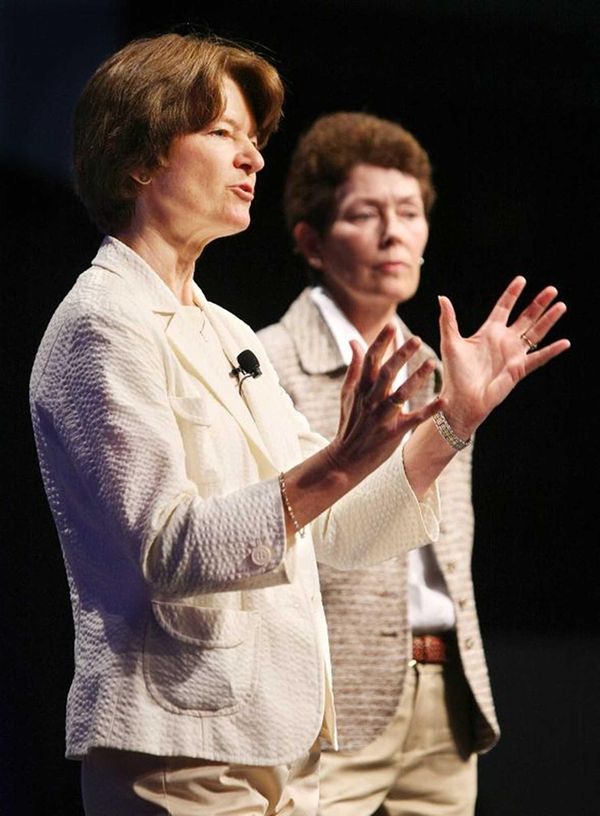
Did You Know...that the late astronaut Sally Ride was the first American woman in space? She was also the only astronaut chosen for President Reagan's Rogers Commission to investigate the Space Shuttle Challenger accident.
| Sally Ride (foreground) and life partner Tam O'Shaugnessy. Photo: American Library Association and AP News, 2008. |
Later in life, Sally Ride helmed various projects and organizations designed to increase the public's awareness of and interest in science and space exploration. After a stint as professor of physics at University of California, San Diego, Ride became President of CalSpace; joined the board of directors for Space.com; founded the NASA-affiliated EarthKAM earth-from-space photography project; and eventually started Sally Ride Science. The latter is an organization devoted to supporting young womens' interests in science, math, engineering, and technology.
To read more about the life and times of Sally Ride (born May 26, 1951 and died July 24th, 2012), please see her online full-text biography in our Sawyer database, Biography in Context.
Notable E-Books:
- Leaving earth [electronic resource] : space stations, rival superpowers, and the quest for interplanetary travel, by Robert Zimmerman.
- A dictionary of space exploration [electronic resource], edited by E. Julius Dasch.
Monday, July 9, 2012
New Database: Business Insights: Essentials
We are fortunate enough to get access to several additional databases through the MBLC & MLS with Commonwealth of Massachusetts and Federal funding. The majority of these come from Gale/Cengage. And these include electronic resources like the useful Academic OneFile. This summer, there are some database changes. One is a switch from a database called Business & Company Resource Center (which is no longer available) to one called Business Insights: Essentials (BIE).
BIE is a brand new database. So much so that one of the few web sheets about the file still says "coming soon!" It is designed to be a multi-purpose database that provides a variety of company- and industry-specific resources. According to the publisher, the file allows users to:
• Easily research companies, industries and business topics in the context of timely news and reports
• Instantly analyze and compare financial and statistical data with interactive charting tools
• Utilize data from Gale staple publications, including International Directory of Company Histories, Market Share Reporter, Business Rankings Annual, Encyclopedia of American Industries and many others
• Access company profiles and industry rankings, as well as brand and product information
• Access SWOT reports, financial analysis tools, business associations, investment reports and market research reports.
Although you can select certain options from the dark gray bar near the top of the landing page, that isn't necessarily the best approach. For example, if you click "Industries" you don't get an industry search page, but rather over 1100 listed industries in an alphabetical list. So, it is easier to either type in a basic search in the opening screen or click the Advanced Search option just beneath the orange search button. A basic search isn't a bad starting point.
Like Ebsco's excellent Business Source Complete, it easy to sort and limit your results (as in the above, too large--over 137,000 results!--search for footwear) using the refining options in the left frame.
The many materials featured in the database include:
• More than 2 million investment research/brokerage reports
• Thousands of detailed financial reports (including fundamentals data and comparison tools)
• More than 2,500 market research reports
• More than 3,900 full-text periodicals
• More than 1,000 SWOT reports (updated quarterly)
• Nearly 25,000 industry reports
• Nearly 11,000 company histories
• Approximately 43,400 Market Share articles
• More than 65,000 articles from Gale’s Business Rankings Annual
• Nearly 2,300 corporate chronologies
• More than 2,000 additional reference articles published by Gale
One of the nifty tools you can access is one that allows you to compare companies or industries. (Click "Comparison Charts" on the right of the dark gray menu bar.) If you are doing company comparisons, the trick may be picking the right parent firm from the suggestions offered. For better results, use the ticker symbol instead of word name in the search box. Here's an example of a comparison between Nike and Skechers. I can change the point of comparison, add or remove companies, change the display option, and print or save in a variety of file formats. (Each dot on the chart is a data point.)
For training videos from the publisher, please see:
- Performing a Business and Company Resource Center Company Search using Business Insights: Essentials (3:08)
- Performing a Business and Company Resource Center Industry Search using Business Insights: Essentials (2:00)
- Performing a Business and Company Resource Center Article Search using Business Insights: Essentials (2:14)
- Basics (3:40)
- Content Types (5:50)
- Searching (5:56)
So here is another business research tool to explore! We hope you find it useful.
[Find Business Insights: Essentials on our A-Z database list, or in our Subject Database List for Business & Management.]
Subscribe to:
Posts (Atom)