No single blog post could ever encompass the enormous tragedy of World War II. For that matter, many books only try to take on selected aspects of the war, its causes, and consequences. Here is a small sample of book titles available at the Sawyer Library:
Print:
Swansong 1945: A Collective Diary of the Last Days of the Third Reich
By Walter Kempowski; translated from the German by Shaun Whiteside.
Five Days that Shocked the World:
Eyewitness Accounts from Europe at the End of World War II
By Nicholas Best
The Holocaust and the Revival of Psychological History
By Judith M. Hughes
E-Books:
The War in the Empty Air:
Victims, Perpetrators, and Postwar Germans"
By Dagmar Barnouw
Getting History Right:
East and West German Collective Memories of the Holocaust and War"
By Mark A. Wolfgram
The War Complex:
World War II in Our Time
By Marianna Torgovnick
a communication tool from the Mildred F. Sawyer Library at Suffolk University in Boston, Massachusetts.
Showing posts with label Did You Know..... Show all posts
Thursday, May 7, 2015
Friday, February 13, 2015
Frank Wedekind and his play "Spring's Awakening"
In coordination with this year's Pioneer Performance Series production of Spring Awakening, the musical, (based on a 19th century German play by Frank Wedekind), and Professor Jay Rosellini's presentation about the original work and Wedekind’s legacy in drama history, the Sawyer Library is highlighting items in the Library's collection related to the play and its German author.
The contemporary production:
- Spring Awakening
Book and lyrics by Steven Sater ; music by Duncan Sheik. Online access via eBrary. - Spring Awakening : In the Flesh
Written by David Cote ; principal photography by Doug Hamilton and Joan Marcus.
- Spring's Awakening: Tragedy of Childhood
By Frank Wedekind; English version and ten notes by Eric Bentley
- Frühlings Erwachen : eine Kindertragödie
Frank Wedekind ; mit einem Nachwort von Georg Hensel
Biography and criticism of Frank Wedekind (1864-1918):
-
Frank Wedekind
By Sol Gittleman -
Frank Wedekind
by Alan Best
- Twentieth-Century German Dramatists, 1889-1918
Access book at Gale's Dictionary of Literary Biography Online -
The Playwright & Historical Change; Dramatic Strategies in Brecht, Hauptmann, Kaiser & Wedekind
By Leroy R. Shaw
- The Cambridge Companion to
Modern German Culture
View full text via Cambridge Online
Reviews of performances, and articles about the play, from
the New York Times, spanning from 1908 to 2008.
All are available online to Suffolk University students and staff, via
the Historic New York Times database.
- Isherwood, Charles. "Injecting Real Youth into a Youthful show." New York Times (1923-Current file): 1. Sep 15 2008. ProQuest. Web. 8 Jan. 2015.
- BELLAFANTE, GINIA. "Sex, Repressed and Unleashed." New York Times (1923-Current file): 2. Feb 09 2007. ProQuest. Web. 8 Jan. 2015.
- Isherwood, Charles. "THEATER REVIEW: A Rock 'n' Roll Heartbeat for German Schoolboys of the 19th Century." New York Times (1923-Current file): 1. Jun 16 2006. ProQuest. Web. 8 Jan. 2015.
- SISARIO, BEN. "Duncan Sheik." New York Times (1923-Current file): 1. Feb 26 2006. ProQuest. Web. 8 Jan. 2015.
- Gussow, MEL. "Stage: Juilliard Players do 'Spring Awakening'." New York Times (1923-Current file): 40. Dec 19 1977. ProQuest. Web. 8 Jan. 2015.
- Funke, LEWIS. "Theater: Wedekind's 'the Awakening of Spring': Sex-Education Sermon at Pocket Theater 1891 Play Conveys Air of a Museum Piece." New York Times (1923-Current file): 50. May 13 1964. ProQuest. Web. 8 Jan. 2015.
- Gelb, ARTHUR. "Theatre: Dated Sermon: 'Spring's Awakening'Is an Essay on Sex." New York Times (1923-Current file): 30. Oct 10 1955. ProQuest. Web. 8 Jan. 2015.
- "COURT BARS SEX PLAY: Justice Erlanger Finds "The Awakening of Spring" Unfit for Public." New York Times (1857-1922): 13. May 03 1917. ProQuest. Web. 8 Jan. 2015.
- "THE AWAKENING OF SPRING": A Tragedy of Childhood by the German Playwright, Frank Wedekind." New York Times (1857-1922): 1. Oct 01 1910. ProQuest. Web. 8 Jan. 2015.
- Special Cable to THE NEW,YORK TIMES. "CHILD ACTORS SEEN IN GERMAN SEX PLAY." New York Times (1857-1922): 9. Oct 29 1908. ProQuest. Web. 8 Jan. 2015.
Friday, May 2, 2014
Help Us Choose Books for the Sawyer Library
Patron Driven Acquisition - Help Us Buy Books
Sawyer Library has initiated a Patron Driven Acquisition (PDA) program with eBrary titles. These new titles are listed below. A PDA program means books are purchased only if they are used.
If you are interested in reading any of these books, open one and print a page or two or view it for at least 10 minutes, and we will purchase the book.
Simply search the title in the Suffolk University catalog.
Childism : Confronting Prejudice Against Children
|
Rise of Female Kings in Europe, 1300-1800
|
Sudan and Darfur, and Darfur : What Everyone Needs to Know
|
Sex and the Office : A History of Gender, Power, and
Desire
|
Fandom Unbound : Otaku Culture in a Connected World
|
Women in Business : Navigating Career Success
|
Millennials and the Workplace : Challenges for
Architecting the Organizations of Tomorrow
|
Politics of Crowds
|
Strangers at the Gates
|
Population History of the United States
|
Last Season of Innocence : The Teen Experience in the
1960's
|
Generational Use of New Media
|
Facing Fear : The History of an Emotion in Global
Perspective
|
Buy It Now : Lessons from EBay
|
Humanity : A Moral History of the Twentieth Century,
Second Edition
|
State and the Stork : The Population Debate and Policy
Making in US History
|
Drugs for Life : How Pharmaceutical Companies Define Our
Health
|
Bloomberg Financial : Wealth Regeneration at Retirement :
Planning for a Lifetime of Leadership
|
Climate Change and Human Mobility
|
Pay : Why People Earn What They Earn and What You Can Do
Now to Make More
|
Aging and the Art of Living
|
Unlikely Secret Agent
|
Social Innovation : Blurring Boundaries to Reconfigure
Markets
|
Managing Corporate Social Responsibility : A Communication
Approach
|
Leaderless Economy : Why the World Economic System Fell
Apart and How to Fix It
|
Demography of Roman Italy
|
Foreign Intervention in Africa
|
Peasants, Citizens and Soldiers
|
Global Crisis : War, Climate Change and Catastrophe in the
Seventeenth Century
|
Do Good Well : Your Guide to Leadership, Action, and
Social Innovation
|
TRIOS : Occupy : Three Inquiries in Disobedience
|
Au Pair (2nd Edition)
|
Global Political Hot Spots : Congo (2nd Edition)
|
Excess : Anti-consumerism in the West
|
Human Capitalism : How Economic Growth Has Made Us Smarter
- and More Unequal
|
Children and the Internet
|
Cosmopolitanism and Culture
|
Liberalization in Aviation : Competition, Cooperation and
Public Policy
|
Creating a New Civilization through Social
Entrepreneurship
|
Population, Fear, and Uncertainty : The Global Spread of
Fertility Decline (2nd Edition)
|
After the Death of Childhood
|
Timewatch : The Social Analysis of Time
|
Evolutionary Psychology : A Clinical Introduction
|
Society under Siege
|
Immigrant Women Workers in the Neoliberal Age
|
Ringtone Dialectic : Economy and Cultural Form
|
Third Industrial Revolution in Global Business
|
Mass Flourishing : How Grassroots Innovation Created Jobs,
Challenge, and Change
|
Identity, Citizenship, and Violence in Two Sudans :
Reimagining a Common Future
|
Protestantism and Progress : A Historical Study of the
Relation of Protestantism to the Modern World
|
Communities and Networks : Using Social Network Analysis
to Rethink Urban and Community Studies
|
Fangasm : Supernatural Fangirls
|
Information Society : Issues and Illusions
|
New Cold War History : Visions of Freedom : Havana,
Washington, Pretoria, and the Struggle for Southern Africa, 1976-1991
|
Short History of the Twentieth Century
|
MIT Press Essential Knowledge : Memes in Digital Culture
|
Empire of the Air : Aviation and the American Ascendancy
|
Transport and Society : Strategies for Sustainable
Mobilities : Opportunities and Challenges
|
Digital Politics in Western Democracies : A Comparative
Study
|
What Everyone Needs to Know : Economic Development : What
Everyone Needs to Know
|
Fan CULTure : Essays on Participatory Fandom in the 21st
Century
|
Cultural Politics of Media and Popular Culture : Media and
the Rhetoric of Body Perfection : Cosmetic Surgery, Weight Loss and Beauty in
Popular Culture
|
Collaborative Media : Production, Consumption, and Design
Interventions
|
Social Movements in Global Politics
|
Financial Management Association Survey and Synthesis :
Too Much Is Not Enough : Incentives in Executive Compensation
|
Consuming Work : Youth Labor in America
|
TechnoFeminism
|
Where the Negroes Are Masters : An African Port in the Era
of the Slave Trade
|
Will the Middle East Implode?
|
Modern Intellectual and Political History of the Middle
East : Raging Against the Machine : Political Opposition Under
Authoritarianism in Egypt
|
Wasted Lives : Modernity and Its Outcasts
|
In 100 Years : Leading Economists Predict the Future
|
Global Development Crisis
|
Twentieth-Century Europe : A Brief History (3rd Edition)
|
Beyond Sustainability : A Thriving Environment
|
Violent Accounts : Understanding the Psychology of
Perpetrators Through South Africa's Truth and Reconciliation Commission
|
Ain't Got No Home : America's Great Migrations and the
Making of an Interracial Left
|
Protest Inc. : The Corporatization of Activism
|
People, Planet and Profit : Socio-Economic Perspectives of
CSR
|
Connecting the Greater West Series : Working Women into
the Borderlands
|
Modern African Writing Series : 491 Days : Prisoner Number
1323/69
|
Labels:
Circulation Notes,
Did You Know....,
Library News
Wednesday, April 23, 2014
Help with Constructing a Works Cited List (Bibliography) using MLA or APA:
It's April, also known as term paper season.
That means gathering and formatting your list of sources to include on your 'works cited list' (also referred to as a 'reference list' or 'bibliography'). Most students are required to use either the MLA or APA style of citations.
Here are some links to guides which will offer some help with this (unpleasant, but) necessary step in writing a research paper. Note in particular the following guides:
That means gathering and formatting your list of sources to include on your 'works cited list' (also referred to as a 'reference list' or 'bibliography'). Most students are required to use either the MLA or APA style of citations.
Here are some links to guides which will offer some help with this (unpleasant, but) necessary step in writing a research paper. Note in particular the following guides:
- Citing Your Sources - APA Style
- Citing Your Sources - MLA Style
- Citations: Deciphering and Using Them
- RefWorks
- RefWorks Resource Guide (i.e. a how-to guide)
- NoodleBib
- Citation Tools in Sawyer Library Databases
Wednesday, March 12, 2014
New Book: "The Simpsons and their Mathematical Secrets"
The animated sit-com, "The Simpsons," has made its way into American popular culture, both as a reflection and as an influence. But did you know that for all these years, it has also been sneaking in references to high level mathematics? This is according to the new book The Simpsons and their Mathematical Secrets"
The author, Simon Singh, is both a fan of the show and has his Ph.D. in particle physics. According to the book's summary, Singh noticed and documented so many allusions to math in The Simpsons, that it could "form the basis of an entire university course."
Friday, November 15, 2013
Sawyer Library Hidden Treasure: Europe Since Versailles
This latest unburied 4th floor Sawyer Library gem, Europe Since Versailles, features political cartoons drawn by Sir David Low from the decades between World War I and World War II. During this time of shaky peace, Sir Low's caricatures lambasted world nations and their leaders as their political interactions frequently presaged being sucked into a second world war. So pointed were the critiques against Nazi "governance" in particular, that Adolf Hitler himself placed Sir David Low on a list of people to be rounded up after Germany's conquest over England (Streicher, 6). Fortunately for Low, England never fell to Germany, and he continued designing scathing editorial cartoons, thumbing his nose at Hitler's apoplectic rage. In this reprinted edition of Sir David Low's works, Lawrence Streicher has added an introduction, epilogue, and partial bibliography of Low's collected works. Frequent characters in Low's satirical cartoons include: Maxim Litvinov, Neville Chamberlain, Pierre Laval, Adolf Hitler, Benito Mussolini, Aristide Briand, and Joseph Stalin. Check out this item to chuckle at sharp images depicting the ineffectiveness of politics (my, how things change!), or bemoan the inevitability of civilian pain and suffering at the end of this era.
Image credit: "DAVID LOW (English Cartoonist)" belongs to Flickr user NCMallory. License to use: CC BY 2.0 (http://creativecommons.org/licenses/by/2.0/deed.en)
Friday, August 16, 2013
Sawyer Library Hidden Treasure: Portrait of an Age
Re-discovered in the Sawyer Library 4th floor collection, Portrait of an Age contains a rich assemblage of un-posed and frequently un-authorized photographs taken by Erich Salomon from the late 1920s to the beginning of WWII. Pictorial historiographer, pioneer in the art of photojournalism, and master of the well-placed hidden camera, Salomon was known among politicians of Europe as “the king of the indiscrete” (66). This collection of Salomon’s candid photos, selected by Han de Vries and Peter Hunter-Salomon, shows political life in action at the League of Nations and throughout Europe, and highlights living scenes among royalty, well-known historical personages of Europe and America, and the every-day person of the era. Notable figures photographed by Salomon include: Albert Einstein, Igor Stravinsky, Arturo Toscanini, Franklin Delano Roosevelt, Marlene Dietrich, Upton Sinclair, Duchess of York (Queen Mother Elizabeth) Winston S. Churchill, Benito Mussolini and Klara Zetkin. Check out this item to view through Erich Salomon’s lens the period style, the interactions among rulers and politicos, the action at exclusive royal banquets, and some of daily life during the years between World Wars I and II.
Table of Contents:
Table of Contents:
- Who was Erich Salomon?
- The epoch of the League of Nations
- Germany in 1930
- Europe and its conferences
- The year in Geneva
- Judges and courts
- Artists, intellectuals, and society
- America in 1930
- A look at France in 1935
- On the eve of World War II
Wednesday, January 16, 2013
Did You Know...We Have Our Own Google Scholar!
Although your average reference librarian will usually suggest that using one or more of our (expensive) fulltext-rich, enhanced scholarly databases is the best way to tackle most academic research, we also recognize that people love to just Google their topics. The massive, scatter-shot nature of Google always ensures that you will get some results, no matter what you plug into the search box. And if those results are not the best possible research materials, many students (and some faculty) don't much care.
Google is smart enough to know that to be all things to all people, they needed to help academics winnow out more scholarly materials when they search. Hence, Google Scholar. The company says that "Google Scholar provides a simple way to broadly search for scholarly literature. From one place, you can search across many disciplines and sources: articles, theses, books, abstracts and court opinions, from academic publishers, professional societies, online repositories, universities and other web sites. Google Scholar helps you find relevant work across the world of scholarly research." And although they are not exactly transparent about what goes in and what doesn't, they do have information about inclusion and metrics at this page.
One of the (several) frustrations about Google Scholar is, however, that much of the scholarly literature they index is in publisher databases that charge a lot of money. If a database doesn't know who you are or how you are academically-affiliated, they will likely offer to provide easy access to a wide variety of peer-reviewed journal articles if you are willing to provide credit card information and pay between $15 and $75 dollars to view and download them. But, remember those expensive databases I mentioned in the first paragraph? We own or subscribe to a myriad of them. And those databases might well provide "free" access to those same articles as long as you are a current student or faculty of CAS/SBS! But YOU MUST GO THROUGH OUR VERSION OF GOOGLE SCHOLAR.
As you can see from the URL in this screenshot, the link to Google Scholar that you find on our homepage or in our LibGuides actually runs through our proxy server, allowing you to be authenticated and recognized as a Suffolk University researcher, no matter where you are, 24/7.
So when you do a search and get results, a great many of the articles that might come from sources like JSTOR, Wiley Online Library, Sage Journals Online and other databases, will open for you (after you authenticate) when you click on the title.
Keep an eye out for the 360Link that you sometimes see to the right. This will check our eJournal Locator across all databases. This clickable access can make research much easier. But be aware of two things. First, not all materials cited in Google Scholar come from scholarly journal databases. And, secondly, like all libraries, we do not own all items or all databases. So, our version of Google Scholar can be a great help, it is not the magic bullet of universal literature access. (Alas, universal open access is just a dream we dreamed.)
Also, consider using the Advanced Search Option in Google Scholar--
a hard-to-spot popup box. Here, you can indicate an author you want, look for an exact phrase (even just in the title of the article) or specify a date range. This allows for (slightly) more focused searching.
But there are other things that Google Scholar can be useful for besides providing a wide-ranging index with links. Did you know that many people use it to track cited references of important articles? For an explanation of that, see this LibGuide page. And related to this, some software and services actually use Google Scholar to do the kind of "citation analysis" we usually associate with the "impact factor." Publish or Perish is an example.
And did you know that you can export Google Scholar references to RefWorks? It's one of the "Settings."
And for more on RefWorks, see this guide.
So, yes, Google Scholar can be a useful tool because it searches across so many materials. But it is essential that you critically evaluate the items you find in it--especially those NOT from a peer-reviewed journal. There are some sources in Google Scholar (like other student term papers) that your professor will probably not want to see on your bibliography.
Bottom line, if you are planning on using Google Scholar, be cautious and critical. And if you are a member of the Suffolk community, be sure to use our version to reduce dead-end (or costly) frustration!
Google is smart enough to know that to be all things to all people, they needed to help academics winnow out more scholarly materials when they search. Hence, Google Scholar. The company says that "Google Scholar provides a simple way to broadly search for scholarly literature. From one place, you can search across many disciplines and sources: articles, theses, books, abstracts and court opinions, from academic publishers, professional societies, online repositories, universities and other web sites. Google Scholar helps you find relevant work across the world of scholarly research." And although they are not exactly transparent about what goes in and what doesn't, they do have information about inclusion and metrics at this page.
One of the (several) frustrations about Google Scholar is, however, that much of the scholarly literature they index is in publisher databases that charge a lot of money. If a database doesn't know who you are or how you are academically-affiliated, they will likely offer to provide easy access to a wide variety of peer-reviewed journal articles if you are willing to provide credit card information and pay between $15 and $75 dollars to view and download them. But, remember those expensive databases I mentioned in the first paragraph? We own or subscribe to a myriad of them. And those databases might well provide "free" access to those same articles as long as you are a current student or faculty of CAS/SBS! But YOU MUST GO THROUGH OUR VERSION OF GOOGLE SCHOLAR.
As you can see from the URL in this screenshot, the link to Google Scholar that you find on our homepage or in our LibGuides actually runs through our proxy server, allowing you to be authenticated and recognized as a Suffolk University researcher, no matter where you are, 24/7.
So when you do a search and get results, a great many of the articles that might come from sources like JSTOR, Wiley Online Library, Sage Journals Online and other databases, will open for you (after you authenticate) when you click on the title.
Keep an eye out for the 360Link that you sometimes see to the right. This will check our eJournal Locator across all databases. This clickable access can make research much easier. But be aware of two things. First, not all materials cited in Google Scholar come from scholarly journal databases. And, secondly, like all libraries, we do not own all items or all databases. So, our version of Google Scholar can be a great help, it is not the magic bullet of universal literature access. (Alas, universal open access is just a dream we dreamed.)
Also, consider using the Advanced Search Option in Google Scholar--
a hard-to-spot popup box. Here, you can indicate an author you want, look for an exact phrase (even just in the title of the article) or specify a date range. This allows for (slightly) more focused searching.
But there are other things that Google Scholar can be useful for besides providing a wide-ranging index with links. Did you know that many people use it to track cited references of important articles? For an explanation of that, see this LibGuide page. And related to this, some software and services actually use Google Scholar to do the kind of "citation analysis" we usually associate with the "impact factor." Publish or Perish is an example.
And did you know that you can export Google Scholar references to RefWorks? It's one of the "Settings."
And for more on RefWorks, see this guide.
So, yes, Google Scholar can be a useful tool because it searches across so many materials. But it is essential that you critically evaluate the items you find in it--especially those NOT from a peer-reviewed journal. There are some sources in Google Scholar (like other student term papers) that your professor will probably not want to see on your bibliography.
Bottom line, if you are planning on using Google Scholar, be cautious and critical. And if you are a member of the Suffolk community, be sure to use our version to reduce dead-end (or costly) frustration!
Thursday, July 26, 2012
Sally Ride
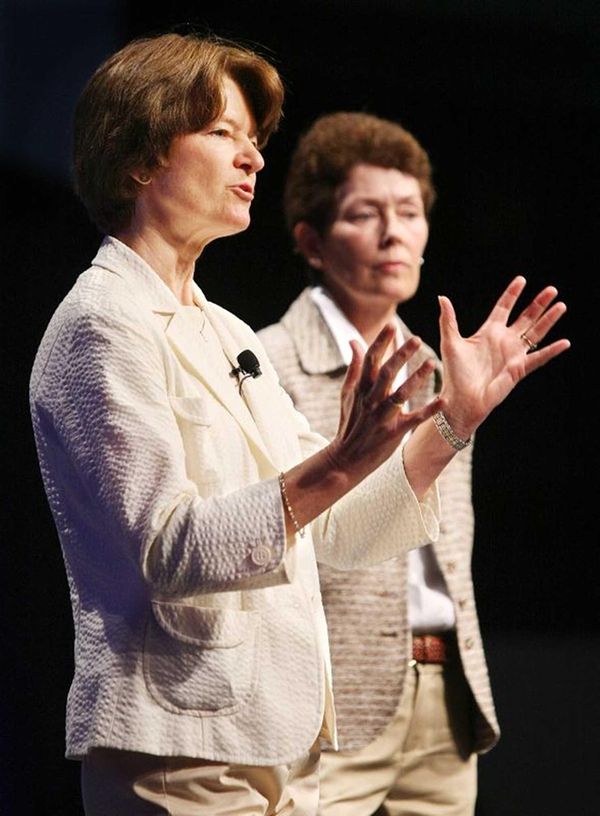
Did You Know...that the late astronaut Sally Ride was the first American woman in space? She was also the only astronaut chosen for President Reagan's Rogers Commission to investigate the Space Shuttle Challenger accident.
| Sally Ride (foreground) and life partner Tam O'Shaugnessy. Photo: American Library Association and AP News, 2008. |
Later in life, Sally Ride helmed various projects and organizations designed to increase the public's awareness of and interest in science and space exploration. After a stint as professor of physics at University of California, San Diego, Ride became President of CalSpace; joined the board of directors for Space.com; founded the NASA-affiliated EarthKAM earth-from-space photography project; and eventually started Sally Ride Science. The latter is an organization devoted to supporting young womens' interests in science, math, engineering, and technology.
To read more about the life and times of Sally Ride (born May 26, 1951 and died July 24th, 2012), please see her online full-text biography in our Sawyer database, Biography in Context.
Notable E-Books:
- Leaving earth [electronic resource] : space stations, rival superpowers, and the quest for interplanetary travel, by Robert Zimmerman.
- A dictionary of space exploration [electronic resource], edited by E. Julius Dasch.
Tuesday, June 26, 2012
Note to Faculty: Harvard Business Review for Course Work
As you may already know, one of the crown jewels of Ebsco's top-of-the-line business database, Business Source Complete (BSC), is their complete run (back to 1922!) of the Harvard Business Review (HBR), one of the most important business journals ever published. A mix of the popular and practical with the highly academic, HBR is, indeed a valuable journal. That's why B-school professors are often interested in using articles from it for class readings.
Although HBR is in our database with full-text PDFs, you may have noticed the scary warning at the end of the articles that reads:
Generally, when a library leases a database, the use of persistent links (or PURLs) in BlackBoard syllabi would be considered "fair use" at that institution. But Harvard likes to write its own rules, and Ebsco is going along with it.
Therefore, even linking to the database record for an HBR article is, according to Harvard, not an "intended" use of database content, and according to them, verboten unless specifically licensed. So, as a faculty member at Suffolk, you might think that you (or the Bookstore, if they were helping to prepare your CoursePack) might have to email Harvard or go through a process at the Copyright Clearance Center to be able to use HBR for class.
Au contraire! As it so happens, our previous library director contracted via Ebsco to also license something called "Harvard Business Review for Course Work." We pay a large (and I would term it exorbitant) additional annual fee to cover course-related use of HBR. Exactly what does this extra fee cover? Harvard (and Ebsco) have always refused to spell that out. Early in our acquisition process I spoke to a Harvard rep. on the phone and tried to pin down the details. He was evasive. So I finally said that as far as I was concerned "anything short of handing out hundreds of copies of articles to strangers at Park Street Station was covered." And he concurred.
So, if you would like to use HBR in class, PLEASE DO SO. Although, as I say, we have no specifics for this so-called license. However, our interpretation of what we get for the fee is everything warned against in the above statement. That is, you may use HBR articles for:
(We are not copyright attorneys here at the Library, but if you are interested in delving into the nature of "fair use," you might want to look through our LibGuide on the Ethical Use of Information.)
We pay this very large fee to keep all Suffolk use of HBR covered, so please utilize this resource! Simply access the journal via links in our eJournal Locator or our Online Catalog, and identify the articles you want to use. Print them, download PDFs, or copy and paste the "Permalink" you can capture from a BSC record into your syllabus.
Ignore the warnings at the end of articles and please do NOT pay additional fees at Harvard Publishing or at CCC for Suffolk use of HBR. (Alas, the fair thing would be for those warnings to not appear on our copies of HBR articles. And BSC Permalinks should only work for institutions that pay the extra fee, like us. Harvard Publishing and the CCC should also refuse to accept additional HBR fees from anyone affiliated with Suffolk. But the world is not a fair one, so it is important for you to remember that you are completely covered for all HBR use while you teach at Suffolk....and while we can continue to pay this fee.)
If you want more information on PURL use in class readings, you might want to consult this general PURL guide and this one specific to BlackBoard.
And happy reading in the Harvard Business Review!
Although HBR is in our database with full-text PDFs, you may have noticed the scary warning at the end of the articles that reads:
"Harvard Business Review Notice of Use Restrictions,
May 2009Harvard Business Review and Harvard Business Publishing Newsletter
content on EBSCOhost is licensed for the private individual use of authorized
EBSCOhost users. It is not intended for use as assigned course material in
academic institutions nor as corporate learning or training materials in
businesses. Academic licensees may not use this content in electronic reserves,
electronic course packs, persistent linking from syllabi or by any other means of
incorporating the content into course resources. Business licensees may not
host this content on learning management systems or use persistent linking or
other means to incorporate the content into learning management systems.
Harvard Business Publishing will be pleased to grant permission to make this
content available through such means. For rates and permission, contact
permissions@harvardbusiness.org."
Generally, when a library leases a database, the use of persistent links (or PURLs) in BlackBoard syllabi would be considered "fair use" at that institution. But Harvard likes to write its own rules, and Ebsco is going along with it.
Therefore, even linking to the database record for an HBR article is, according to Harvard, not an "intended" use of database content, and according to them, verboten unless specifically licensed. So, as a faculty member at Suffolk, you might think that you (or the Bookstore, if they were helping to prepare your CoursePack) might have to email Harvard or go through a process at the Copyright Clearance Center to be able to use HBR for class.
Au contraire! As it so happens, our previous library director contracted via Ebsco to also license something called "Harvard Business Review for Course Work." We pay a large (and I would term it exorbitant) additional annual fee to cover course-related use of HBR. Exactly what does this extra fee cover? Harvard (and Ebsco) have always refused to spell that out. Early in our acquisition process I spoke to a Harvard rep. on the phone and tried to pin down the details. He was evasive. So I finally said that as far as I was concerned "anything short of handing out hundreds of copies of articles to strangers at Park Street Station was covered." And he concurred.
So, if you would like to use HBR in class, PLEASE DO SO. Although, as I say, we have no specifics for this so-called license. However, our interpretation of what we get for the fee is everything warned against in the above statement. That is, you may use HBR articles for:
- Electronic Reserves
- Course Packs (prepared by you or by the SU Bookstore for Suffolk student use)
- Persistent Linking to BSC/HBR Articles in Online Syllabi, Emails or BlackBoard Postings
- Even making Multiple Photocopies from a PDF and handing them out in class!
(We are not copyright attorneys here at the Library, but if you are interested in delving into the nature of "fair use," you might want to look through our LibGuide on the Ethical Use of Information.)
We pay this very large fee to keep all Suffolk use of HBR covered, so please utilize this resource! Simply access the journal via links in our eJournal Locator or our Online Catalog, and identify the articles you want to use. Print them, download PDFs, or copy and paste the "Permalink" you can capture from a BSC record into your syllabus.
Ignore the warnings at the end of articles and please do NOT pay additional fees at Harvard Publishing or at CCC for Suffolk use of HBR. (Alas, the fair thing would be for those warnings to not appear on our copies of HBR articles. And BSC Permalinks should only work for institutions that pay the extra fee, like us. Harvard Publishing and the CCC should also refuse to accept additional HBR fees from anyone affiliated with Suffolk. But the world is not a fair one, so it is important for you to remember that you are completely covered for all HBR use while you teach at Suffolk....and while we can continue to pay this fee.)
If you want more information on PURL use in class readings, you might want to consult this general PURL guide and this one specific to BlackBoard.
And happy reading in the Harvard Business Review!
Labels:
Database Use Tips,
Did You Know....,
Note to Faculty
Location:
59-99 Tremont St, Boston, MA 02108, USA
Monday, April 12, 2010
Link of the Week: The Economic Census
Most people are familiar with the U.S. Census, which is supposed to count every U.S. resident and is conducted every 10 years. (2010 is a census year - so if you have not returned your census form yet, here is what your community stands to gain by having a high participation rate.)
However, the Census Bureau also conducts an Economic Census. This is done every 5 years, the most recent one being from 2007. The data collected provides a detailed snapshot of the U.S. economy, by counting the number of establishments nationwide, their sales, their annual payroll, and the number of their employees. The Census Bureau then assigns each establishment to a specific industry, according to the North American Industry Classification System (NAICS). The 2007 NAICS is comprised of 1,175 industries grouped into 20 sectors, and by means of the Economic Census, these industries can in turn be viewed from the national to the local level.
Why would someone who is not a government official be interested in such things? The statistics can provide a tool to identifying business markets and competition. Comparing changes from one census to the next can illustrate trends in industries by location (or for that matter, trends in different locations by industry).
It takes some time before the Economic Census data is compiled and released. This is done in stages, and the bulk of the data sets are available 2-3 years after the census is conducted.

Not surprisingly, finding and using the data effectively can be a challenge, but there are tools available to help.
One is a reference book held by the Sawyer Library: Industry Research Using the Economic Census : How to Find It, How to Use It, by Jennifer C. Boettcher and Leonard M. Gaines.
Other tools come from the Census Bureau itself, which has posted a User Guide and instruction materials (Power Point slides and handouts) from conference lectures held around the country. The instruction materials and included exercises are especially helpful, since they provide an insight into the types of queries the Economic Census can answer.
However, the Census Bureau also conducts an Economic Census. This is done every 5 years, the most recent one being from 2007. The data collected provides a detailed snapshot of the U.S. economy, by counting the number of establishments nationwide, their sales, their annual payroll, and the number of their employees. The Census Bureau then assigns each establishment to a specific industry, according to the North American Industry Classification System (NAICS). The 2007 NAICS is comprised of 1,175 industries grouped into 20 sectors, and by means of the Economic Census, these industries can in turn be viewed from the national to the local level.
Why would someone who is not a government official be interested in such things? The statistics can provide a tool to identifying business markets and competition. Comparing changes from one census to the next can illustrate trends in industries by location (or for that matter, trends in different locations by industry).
It takes some time before the Economic Census data is compiled and released. This is done in stages, and the bulk of the data sets are available 2-3 years after the census is conducted.

Not surprisingly, finding and using the data effectively can be a challenge, but there are tools available to help.
One is a reference book held by the Sawyer Library: Industry Research Using the Economic Census : How to Find It, How to Use It, by Jennifer C. Boettcher and Leonard M. Gaines.
Other tools come from the Census Bureau itself, which has posted a User Guide and instruction materials (Power Point slides and handouts) from conference lectures held around the country. The instruction materials and included exercises are especially helpful, since they provide an insight into the types of queries the Economic Census can answer.
Subscribe to:
Posts (Atom)